QCVN 40:2025/BTNMT is Vietnam’s updated national technical regulation for industrial wastewater. It took effect on 1 September 2025 and replaced QCVN 40:2011/BTNMT. Therefore, owners, EPCs, and equipment suppliers working in Vietnam should now review discharge scope, applicable parameters, and monitoring obligations. In addition, they should check whether a project falls under the new standard now or during the transition period.
What is QCVN 40:2025/BTNMT?
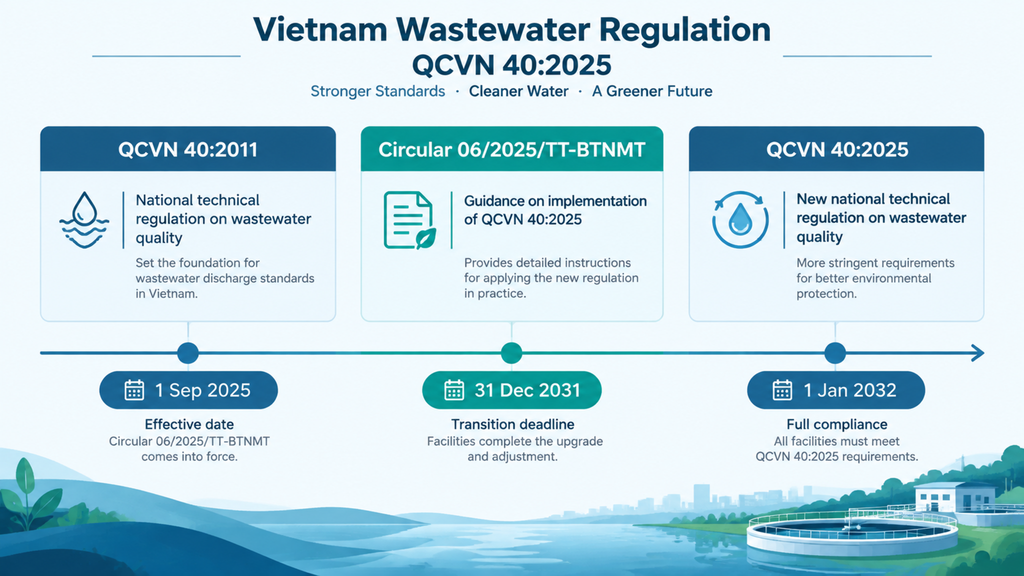
The Ministry of Natural Resources and Environment (MONRE) issued QCVN 40:2025/BTNMT under Circular 06/2025/TT-BTNMT, dated 28 February 2025. The standard sets requirements for industrial wastewater that facilities discharge from production and business activities. In practice, a QCVN is a national technical regulation and is therefore mandatory. This means the updated standard is not optional guidance; facilities must align their treatment design and operating practices with it.
The regulation covers how facilities discharge industrial wastewater and what they must monitor and document. However, because many existing projects still reference the 2011 version, design reviews and acceptance plans should verify which edition applies.
What changed and why it matters
Vietnam’s industrial sector has expanded, and its wastewater rules have changed to match. As a result, documents, equipment specifications, and commissioning tests based on the old standard may no longer be sufficient for international EPCs and importers.
Early attention matters because effluent requirements influence process selection, equipment sizing, instrumentation, and sampling points. Changing these late in a project is more expensive than checking them before procurement.
Effective date and transition
The standard took effect on 1 September 2025. After that date, new investment projects submitted for environmental approval or registration must apply QCVN 40:2025/BTNMT.
In contrast, existing facilities and projects that were already operating, or that had approval or a complete submitted dossier before the effective date, may continue applying the previous standards — including local standards where applicable — until 31 December 2031. From 1 January 2032, those transition cases must also meet QCVN 40:2025/BTNMT. Therefore, the regulation encourages early adoption.
What are the new discharge limits?
Table 1 of the standard sets limits for BOD5, COD, TOC, and TSS. In practice, the applicable column depends on the discharge flow rate (F) and the receiving water body. Columns A, B, and C reflect different levels of protection for the receiving source.
The official text allows a facility to choose TOC or COD; the two are alternatives, not simultaneous requirements.
| Parameter | Unit | F ≤ 2,000 m³/day (A / B / C) | F > 2,000 m³/day (A / B / C) |
| BOD5 (at 20°C) | mg/L | 40 / 60 / 80 | 30 / 50 / 60 |
| COD | mg/L | 65 / 90 / 130 | 60 / 70 / 90 |
| TOC | mg/L | 35 / 50 / 75 | 25 / 40 / 50 |
| TSS | mg/L | 40 / 80 / 120 | 30 / 60 / 80 |
The standard defines Columns A, B, and C as discharge categories. Column A applies to receiving water bodies that supply domestic water or that authorities manage to a higher water-quality level; Column B applies to other receiving water bodies that authorities manage or improve to a specified level; and Column C applies to the remaining receiving waters.
Other parameters to check
In addition, Table 2 sets limits for parameters characteristic of each production activity. Engineers check the values below most often, but a facility-specific review should use the complete table.
| Parameter | Unit | A | B | C |
| pH | — | 6–9 | 6–9 | 6–9 |
| Temperature | °C | ≤ 40 | ≤ 40 | ≤ 40 |
| Total nitrogen (T-N) | mg/L | ≤ 20 | ≤ 40 | ≤ 60 |
| Ammonium (N-NH4+, as N) | mg/L | ≤ 5.0 | ≤ 10 | ≤ 12 |
| Total coliform | MPN or CFU/100 mL | ≤ 3,000 | ≤ 5,000 | ≤ 5,000 |
| Colour | Pt/Co | ≤ 50 | ≤ 100 | ≤ 150 |
For example, total phosphorus limits depend on the receiving water body: lakes and ponds use 2.0 / 2.5 / 3.0 mg/L; rivers for aquaculture, seafood processing, cassava starch, and natural rubber latex processing use 8 / 14 / 18 mg/L; other rivers and sea areas use 4 / 6 / 10 mg/L. Therefore, confirm the correct category against the official text.
The standard also lists limit values for metals and other characteristic pollutants such as arsenic, mercury, lead, chromium, copper, zinc, nickel, cyanide, phenol, mineral oil, and fluoride. Facilities should review those values when the industry category generates them.
Who is affected
According to the official scope, QCVN 40:2025/BTNMT applies to production and business establishments and industrial clusters that discharge industrial wastewater. The exact classification of a facility matters because it determines which parameters apply and how authorities measure and report discharge.
However, facilities that discharge directly to the environment and facilities that connect to a centralized treatment plant may face different requirements. Therefore, confirm the discharge route against the official text before finalizing a design.
In addition, the standard does not apply to wastewater from offshore petroleum extraction, livestock farming, domestic wastewater, or centralized urban and residential wastewater. Separate regulations govern those streams.
What to review in your design and equipment
- First, confirm whether the facility discharges directly or connects to a centralized treatment plant.
- Second, identify the applicable parameters and limits for the facility’s industry category.
- Next, review sampling points, flow measurement, and monitoring equipment.
- Then, check that the treatment process can meet the current limits under realistic influent conditions.
- Finally, align commissioning and acceptance tests with the current standard.
A simple compliance gap check
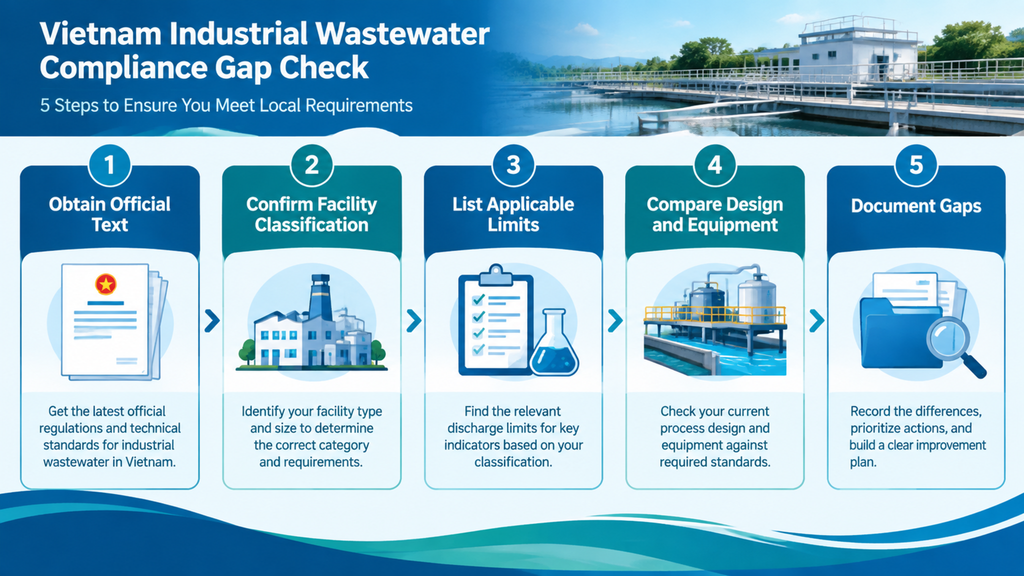
Run a compliance gap check before detailed design or procurement. A short, structured review can identify where an existing design or equipment list falls short.
1. First, obtain the official QCVN 40:2025/BTNMT text and Circular 06/2025/TT-BTNMT.
2. Second, confirm the facility classification and discharge route.
3. Next, list applicable parameters, limits, and monitoring obligations.
4. Then, compare them with the current process design, equipment, and instrumentation.
5. Finally, document gaps and assign owners before commissioning.
How compliance connects to engineering decisions
Compliance is not only a paperwork exercise. Effluent limits drive process selection, equipment sizing, and instrumentation. A plant can meet a limit on paper but still struggle during commissioning if the design does not account for influent variability, sampling points, or measurement methods. Therefore, a technical review should connect the legal requirements to the actual treatment design.
When a facility imports equipment, a supplier’s standard package may not automatically match Vietnam’s current requirements. As a result, owners should check that the offered equipment and its testing conditions align with the applicable limits before placing an order.
Frequently asked questions
What does QCVN 40:2025/BTNMT replace?
It replaces QCVN 40:2011/BTNMT for industrial wastewater.
When did QCVN 40:2025/BTNMT take effect?
It took effect on 1 September 2025.
What is the transition period?
Existing projects that were operating or had approval or a complete submitted dossier before the effective date may continue applying the previous standards until 31 December 2031. From 1 January 2032, they must also meet QCVN 40:2025/BTNMT.
Does the standard cover domestic wastewater?
No. The standard does not cover domestic wastewater or centralized urban and residential wastewater.
Who must comply with QCVN 40:2025/BTNMT?
Production and business establishments and industrial clusters that discharge industrial wastewater, subject to the official scope. Confirm your facility classification.
Is this article legal advice?
No. In short, it provides general information only. For a binding interpretation, consult a qualified local consultant or the relevant Vietnamese authority.
Conclusion
QCVN 40:2025/BTNMT changes the reference point for industrial wastewater projects in Vietnam. In short, an early review of scope, parameters, monitoring, and design alignment can prevent costly rework during commissioning.
Download the Vietnam QCVN 40:2025 Industrial Wastewater Compliance Checklist to structure that review.
Sources
- Circular 06/2025/TT-BTNMT, Ministry of Natural Resources and Environment (MONRE), Vietnam, 28 February 2025. Client-supplied official PDF; public URL: to be verified.
- QCVN 40:2025/BTNMT, Ministry of Natural Resources and Environment (MONRE), Vietnam, 2025. Client-supplied official PDF; public URL: to be verified.
- QCVN 40:2011/BTNMT, Ministry of Natural Resources and Environment (MONRE), Vietnam, 2011. Link: to be verified.
- MONRE official website: https://www.monre.gov.vn
Disclaimer: This article is for general information only and does not constitute legal, regulatory, or engineering advice. Requirements may vary by facility and jurisdiction. Consult a qualified local consultant and the relevant Vietnamese authorities before making compliance decisions.