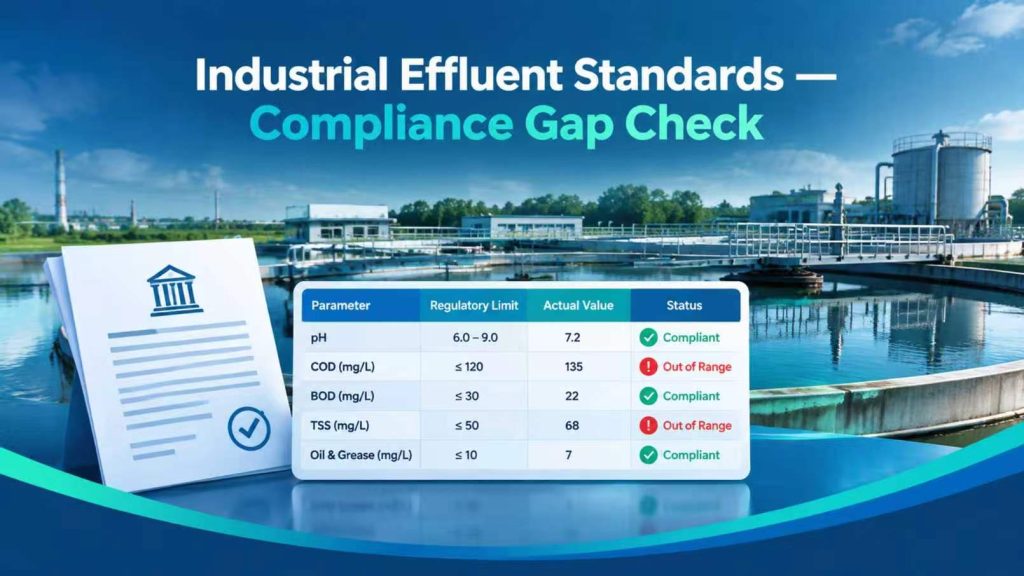
An industrial effluent standards comparison answers a practical question: which legal limits apply to a facility, and how far is the current design from meeting them? In short, a compliance gap check makes that comparison explicit. First, identify the governing regulation. Next, collect the official limits. Then compare them parameter by parameter, and finally translate each gap into a design, equipment, or monitoring action.
What is an industrial effluent standards comparison?
The same factory can face different limits depending on the country, receiving water body, industry sector, and discharge route. For example, a limit may apply at the final discharge point, at the inlet to a centralized treatment plant, or at a sampling point defined in the permit. Therefore, a useful comparison must record the context, not just the numbers.
In addition, an effluent standard usually contains more than BOD5 and COD. It may also define TSS, nitrogen, phosphorus, pH, temperature, coliform, and sector-specific parameters such as metals, oil, phenol, or cyanide. Moreover, it sets sampling and measurement conditions. As a result, a comparison that ignores those conditions can produce a misleading result.
Why effluent limits differ
- First, receiving water objectives differ. A river used for drinking water supply usually has stricter limits than a discharge into a less sensitive receiving water.
- Second, industrial categories differ. Textile, food, chemical, and metal sectors generate different characteristic pollutants.
- Third, national laws and monitoring capacity differ. Countries structure permits, reporting, and enforcement in different ways.
- Finally, discharge routes differ. Direct discharge, connection to a centralized plant, and reuse can each carry separate requirements.
As a result, there is no single universal table that applies everywhere. International references such as WHO water quality guidance and US EPA effluent guidelines can provide context, but the facility must always verify the current local regulation.
How to build the comparison table
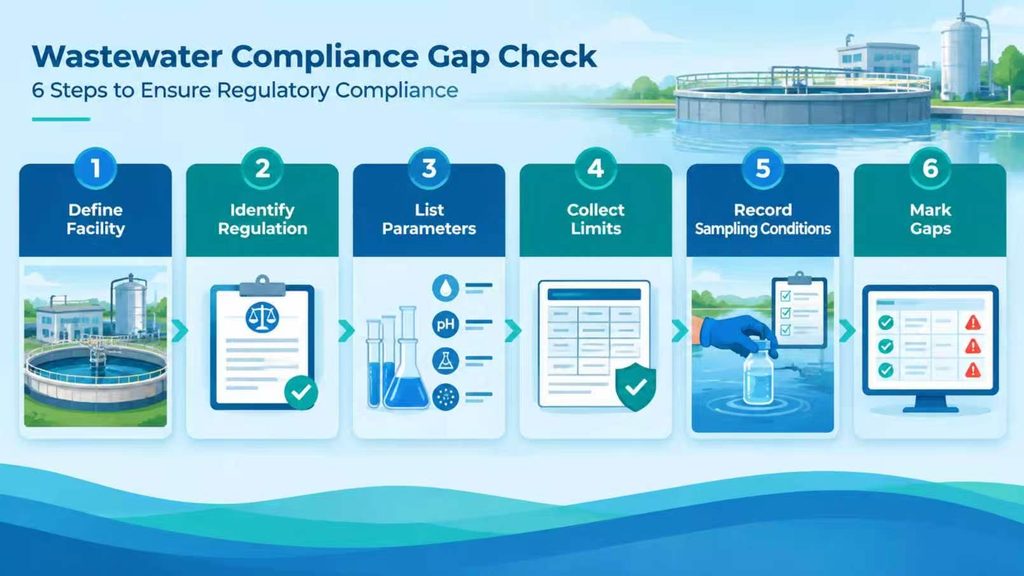
In short, a structured review is usually enough to reveal the biggest risks. Therefore, follow these six steps before detailed design or procurement.
1. First, define the facility classification and discharge route.
2. Next, identify the governing regulation, edition, and effective date.
3. Then, list the applicable parameters and their units.
4. After that, collect the official limit values from the regulation or permit.
5. In addition, record the flow-rate basis, sampling point, and measurement method for each parameter.
6. Finally, mark any missing values or conflicts as items to verify with the authority or a qualified consultant.

Worked example: Vietnam QCVN 40:2025
For example, Vietnam’s updated regulation, QCVN 40:2025/BTNMT, shows why context matters. In practice, core parameter limits depend on discharge flow rate and the receiving water body.
| Parameter | Unit | F ≤ 2,000 m³/day (A / B / C) | F > 2,000 m³/day (A / B / C) |
| BOD5 (at 20°C) | mg/L | 40 / 60 / 80 | 30 / 50 / 60 |
| COD | mg/L | 65 / 90 / 130 | 60 / 70 / 90 |
| TOC | mg/L | 35 / 50 / 75 | 25 / 40 / 50 |
| TSS | mg/L | 40 / 80 / 120 | 30 / 60 / 80 |
Notably, the standard allows a facility to choose TOC or COD, not both. In addition, Columns A, B, and C represent different receiving-water protection levels. For example, Column A generally applies to receiving water bodies with a domestic water supply function, while Column C applies to the remaining receiving waters.
| Parameter | Unit | A | B | C |
| pH | — | 6–9 | 6–9 | 6–9 |
| Temperature | °C | ≤ 40 | ≤ 40 | ≤ 40 |
| Total nitrogen (T-N) | mg/L | ≤ 20 | ≤ 40 | ≤ 60 |
| Ammonium (N-NH4+, as N) | mg/L | ≤ 5.0 | ≤ 10 | ≤ 12 |
| Total coliform | MPN or CFU/100 mL | ≤ 3,000 | ≤ 5,000 | ≤ 5,000 |
| Colour | Pt/Co | ≤ 50 | ≤ 100 | ≤ 150 |
Therefore, for a full review of QCVN 40:2025/BTNMT, including its effective date and transition period, see our guide on Vietnam QCVN 40:2025.
Turn limits into engineering requirements
In short, a comparison table is only useful when it changes decisions. Each limit has a practical consequence.
- First, BOD5 and COD influence biological volume, aeration demand, and carbon dosing.
- Second, TSS influences clarifier or membrane design and final effluent polishing.
- Next, Total nitrogen and ammonium influence anoxic zones, recirculation, and alkalinity control.
- In addition, Total phosphorus influences chemical dosing, sludge production, and solids handling.
- Finally, pH and temperature influence sampling points, material selection, and online instrumentation.
When a facility imports equipment, the supplier’s standard package may not match those requirements. Therefore, owners should check testing conditions, design load assumptions, and performance guarantees against the same official limits.
When to bring in engineering support
In many cases, most teams can complete a first-pass comparison with the official text and a structured table. However, engineering support is useful in several situations.
- For example, the influent is mixed, seasonal, or highly variable.
- In addition, the facility is a retrofit or a brownfield expansion.
- Moreover, the equipment comes from another country with different design assumptions.
- Similarly, the gap involves process sizing, instrumentation, or sampling strategy rather than paperwork only.
- Finally, the permit or authority requires an explanation of the selected parameters.
In those cases, a process design review can connect the legal limits to realistic operating conditions.
Frequently asked questions
What is a wastewater compliance gap check?
In short, it compares a facility’s current design, equipment, and monitoring plan against the applicable effluent limits, then lists the differences and required actions.
Which parameters do I compare first?
First, start with BOD5, COD, TSS, pH, temperature, nitrogen, phosphorus, and any sector-specific pollutants required by the regulation.
Where can I find official effluent limits?
Use the national regulation or permit issued by the environmental authority. However, international references can provide context, but they do not replace the local legal text.
What if the standards use different units or sampling conditions?
First, normalize the values before comparison. Then record the flow-rate basis, sampling point, and measurement method for every parameter.
Is a gap check legal advice?
No. In short, it is an engineering and compliance planning tool. For binding interpretations, consult a qualified local consultant or the relevant authority.
Conclusion
Overall, an industrial effluent standards comparison turns legal requirements into clear engineering decisions. As a result, a structured compliance gap check helps a project team find the real differences before they become expensive commissioning problems.
Therefore, if you need a compliance gap review for an industrial wastewater project, contact us for a technical consultation.
Sources
- QCVN 40:2025/BTNMT, Ministry of Natural Resources and Environment (MONRE), Vietnam, 2025. Client-supplied official PDF.
- Circular 06/2025/TT-BTNMT, Ministry of Natural Resources and Environment (MONRE), Vietnam, 28 February 2025. Client-supplied official PDF.
- World Health Organization (WHO), water, sanitation and health: https://www.who.int (specific page to be verified)
- US EPA industrial effluent guidelines: https://www.epa.gov (specific page to be verified)
- Vietnam Ministry of Natural Resources and Environment: https://www.monre.gov.vn
Disclaimer: This article is for general information only and does not constitute legal, regulatory, or engineering advice. Requirements vary by facility, jurisdiction, and permit. Consult a qualified local consultant and the relevant authorities before making compliance decisions.